2026-08-06
8 best Statuspage alternatives in 2026, free and paid
- status-page
- alternatives
- monitoring
TL;DR.
- Statuspage does not run uptime checks itself. It shows what you or an integration report, so it is usually a second bill on top of a monitoring tool.
- Its price goes up with subscribers, the number you most want to grow.
- Best default: Uptimepage combines the checks and the public page, never charges per subscriber, and runs on the hosted service or on your own server.
- If you like your monitoring and only want the page replaced, Instatus.
- Choose Better Stack when you also need logs and advanced on-call; choose Hyperping for a hosted monitoring and incident-response suite.
- To run the whole incident stack yourself, compare Uptimepage with OneUptime. Upptime and Cachet suit narrower self-hosted jobs.
I should say this first: I build Uptimepage. I picked these eight for four distinct jobs (drop-in page replacement, all-in-one monitoring, broad monitoring, self-hosting) and checked each vendor's official pricing or documentation in August 2026. Pricing and limits move, so verify the current figures before you buy.
What are you actually replacing?
Your shortlist depends on the answer, and this is where people get confused, because Statuspage does less than its price suggests. Atlassian Statuspage is a communication tool, not a monitoring tool. It publishes components, incidents, scheduled maintenance and subscriber notifications. It does not check whether your site is up. Something else has to notice the outage and tell it, by hand or over the REST API. That is why teams paying for Statuspage almost always pay a monitoring vendor as well, and why most tools below look cheaper than they first appear: one price covers both jobs.
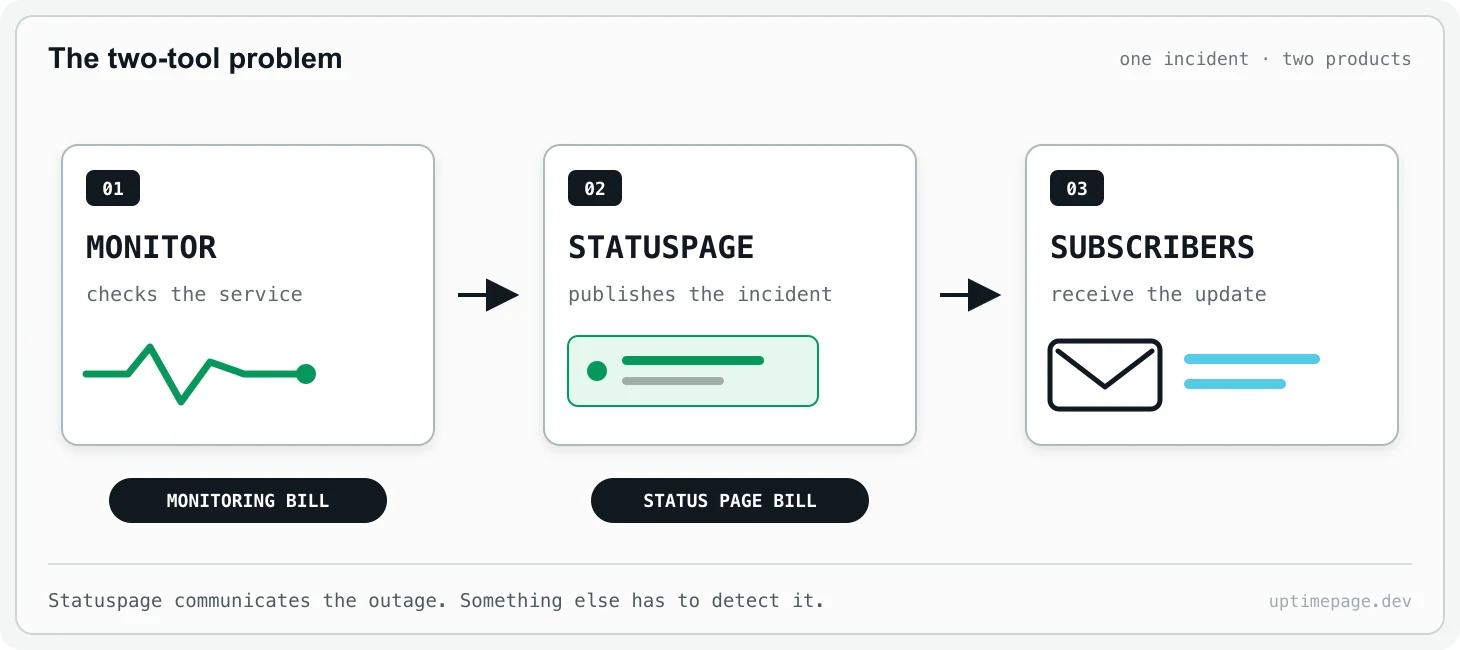
Statuspage handles the second half of the job: publishing the incident. A separate monitor still has to detect the outage, which usually means a second product and a second bill.
The second thing to understand is what the price is based on. Statuspage's public tiers go up with subscribers. The free tier stops at 100 subscribers, 25 components and two team members, and the four paid tiers above it step through 250, 1,000, 5,000 and 25,000 subscribers. The jump between those steps is large every time, not small. Private pages are a separate and more expensive set of tiers that starts at 50 authenticated subscribers, and audience-specific pages cost more again. So the bill grows with the number of customers you persuade to follow your status, which is a strange thing to pay extra for.
None of this makes Statuspage bad. It is the best known page in the category, the incident workflow is mature, and if your team already works in Jira and Opsgenie, nothing else here connects as well. Teams that leave usually leave for the two reasons above, not because the product is weak.
One more thing to check, whatever you choose: does the uptime number on the page come from real checks, or from the incidents somebody remembered to publish? Those are very different promises, and the difference is a status page you cannot fake.
Statuspage alternatives compared
The shortlist, side by side.
| Tool | Best for | Deployment | Free tier | Monitoring | Billed mainly on |
|---|---|---|---|---|---|
| Statuspage | Teams deep in Atlassian | Hosted | 100 subscribers, 25 components, 2 users | No native checks | Subscribers |
| Instatus | Replacing only the page | Hosted | 15 monitors, 200 subscribers, no custom domain | Yes | Plan tier, subscriber caps |
| Better Stack | Monitoring, logs and advanced on-call | Hosted | 10 monitors at 3-min, 1 status page | Yes | Blocks of monitors |
| Hyperping | Hosted monitoring and incident response | Hosted | 20 monitors, 5-min checks, 1 page | Yes | Monitors and seats |
| Uptime.com | A broad probe network and procurement-heavy teams | Hosted, with private probes | No free tier or trial; 30-day money-back | Yes | Plan tier, users unlimited |
| Cachet | A self-hosted page driven by existing monitoring | Self-hosted | Free, you host it | HTTP in v3, you schedule it | Nothing but hosting |
| Upptime | Open-source projects already on GitHub | Self-hosted on GitHub | Free | Yes, via Actions | Nothing but hosting |
| OneUptime | A full incident stack under your control | Hosted or self-hosted | Free self-hosted, paid cloud | Yes | Nothing self-hosted |
| Uptimepage | Monitoring plus a status page without subscriber fees | Hosted or self-hosted | 50 at 60s while the founding tier lasts, then 20 at 3-min | Yes | Monitors, never subscribers |
1. Instatus
Instatus is the closest match if you want to swap Statuspage for something very similar. Look at it first if you like your current monitoring and only want a new page. The pages are fast, clean and genuinely nice to look at. The free tier is generous: 15 monitors with two-minute checks, 200 subscribers, five team members and two on-call members, with email alerts. Pro raises that to 50 monitors at 30-second checks, 5,000 subscribers and a custom domain. One thing to know first: the free tier has no custom domain, so a branded status.yourcompany.com starts on the paid plan. The Instatus tiers also step up with subscribers, the same as Statuspage, so if that is why you are leaving, check the numbers before you move.
2. Better Stack
Better Stack is the broadest answer if you want to replace several operations tools at once. Monitoring, incident management, on-call scheduling and log management sit in one product, so it takes over Statuspage, your monitor, and part of what PagerDuty does. The free tier starts with ten monitors, heartbeats and one status page, though on-call responders are a paid seat on top. Its Terraform provider is vendor maintained and unusually covers on-call policies, and it runs a hosted MCP server with OAuth. The limit is ownership: the product is cloud only, so your data lives with them, and extra monitors are sold in blocks of 50, so the bill keeps growing as you add them. If you are weighing it against Uptimepage, Uptimepage vs Better Stack is my honest side by side.
3. Hyperping
Hyperping bundles monitoring, on-call and a status page on your own domain instead of making you buy three separate products, and few tools here answer Statuspage's "and now buy a monitor too" problem as directly. The free tier is 20 monitors at five-minute checks with one basic status page and a single seat. Essentials, the first paid tier, covers 50 monitors at 30-second checks, three status pages, 100 subscribers, two seats and three browser checks, and it already includes on-call and escalation, which is rare that low down a price list. Pro doubles the monitors to 100 and raises the limits to 10 browser checks and 1,000 subscribers. Yearly billing gives you two months free on any paid tier. Two things go the other way. Five-minute checks on the free tier are too slow to catch short outages, and seats are counted, so a big team costs more than a long list of monitors.
4. Uptime.com
Uptime.com is the broad monitoring option. Every plan includes unlimited users, so nobody pays per seat, and status pages come with email and SMS subscribers, password protection and a custom subdomain instead of costing extra. It runs more than a hundred public probe servers and can put private ones inside your own network, and few tools here have a probe network that big. Its Terraform provider is vendor maintained and shipping. Check that it fits you first, though. There is no free tier and no trial, so you evaluate it on a paid plan, backed by a 30-day money-back guarantee for new accounts. Its breadth is useful for procurement-heavy teams, but a three-person team may be happier further up this list.
5. Cachet
Cachet is the best known self-hosted status page and still the one others get compared with. It began as a pure communication tool, exactly like Statuspage: you set components up or down by hand or over its API. Version 3, in the cachethq/core repo, added component checks and verified email subscribers in mid-2026. The old gap is closing, but those checks are thinner than they sound. They are HTTP only, with none of the TCP, DNS, TLS or ping coverage a dedicated monitor gives you, and nothing schedules them for you: the command exists, but Cachet's own scheduler never calls it, so you add your own cron entry.
Read the licence before you build on it. Cachet 2.x was BSD-3-Clause, but the v3 branch ships a custom source-available licence and declares itself proprietary in composer.json, so v3 is not open source in the way the other self-hosted tools here are. Three more things to expect: the project says v3 is still under active development and not yet ready for production, there is no tagged release, so you install from the repository, and subscriptions are global only, so a customer cannot follow one component and ignore the rest. Pick Cachet if you want something shaped like Statuspage, self-hosted, you already have monitoring that can drive it over the API, and its licence works for you.
6. Upptime
Upptime has the cleverest design here and is the cheapest to run. It runs its checks as scheduled GitHub Actions, stores history as commits in your own repository, files incidents as GitHub Issues and serves a static page from GitHub Pages. There is no server to run and no bill. That design is also the limit: Actions cron will not run more often than every five minutes and often runs late, so short outages go unseen. Alerts go to your own team through Slack, email, SMS or a custom webhook, and there is no subscriber list your customers can join. For an open-source project or a personal site it is close to perfect. For a company that promises customers an SLA, the five-minute limit is the problem. I compare it with the others in Uptimepage vs Upptime, Cachet and Statping.
7. OneUptime
Monitoring, status pages, incident management, on-call rotations and alert workflows all live in one open-source codebase you can self-host for free, with a hosted cloud if you would rather not run it. OneUptime publishes a vendor Terraform provider and an MCP server, though the MCP only supports API-key auth. What it costs you is the work of running it: this is a Docker or Kubernetes deployment with many services, not a single container, so you are taking on a platform. If your team already runs Kubernetes and wants the whole incident process in-house, this is the most complete answer on the list. More on it in my self-hosted uptime monitoring guide.
8. Uptimepage
Uptimepage is the open-source project I maintain, and it is the default I recommend when you want to replace both Statuspage and the monitor behind it. The checks and the public page are one product: a failing check can open an incident and publish it without you wiring two vendors together. It never charges by subscriber. You can use Uptimepage as a hosted status page with monitoring built in and operate nothing, or self-host the same AGPL application on your own infrastructure without changing products later.
Early accounts get the founding tier automatically: 50 monitors at 60-second checks, two status pages and 90-day history, with no card. After that cutoff the base free tier is 20 monitors at three-minute checks and one page. Monitors, pages and alert channels can be managed from the dashboard, REST API, Terraform provider or OAuth MCP server. The tradeoff is scope: Uptimepage does not do log management or RUM, and its incident workflow is deliberately simpler than Atlassian's. Choose Better Stack if logs and advanced on-call are part of the purchase. If your team lives in Jira and Opsgenie and wants the deepest Atlassian integration, Statuspage still wins. The detailed comparison is in Uptimepage vs Statuspage.
How to choose without overthinking it
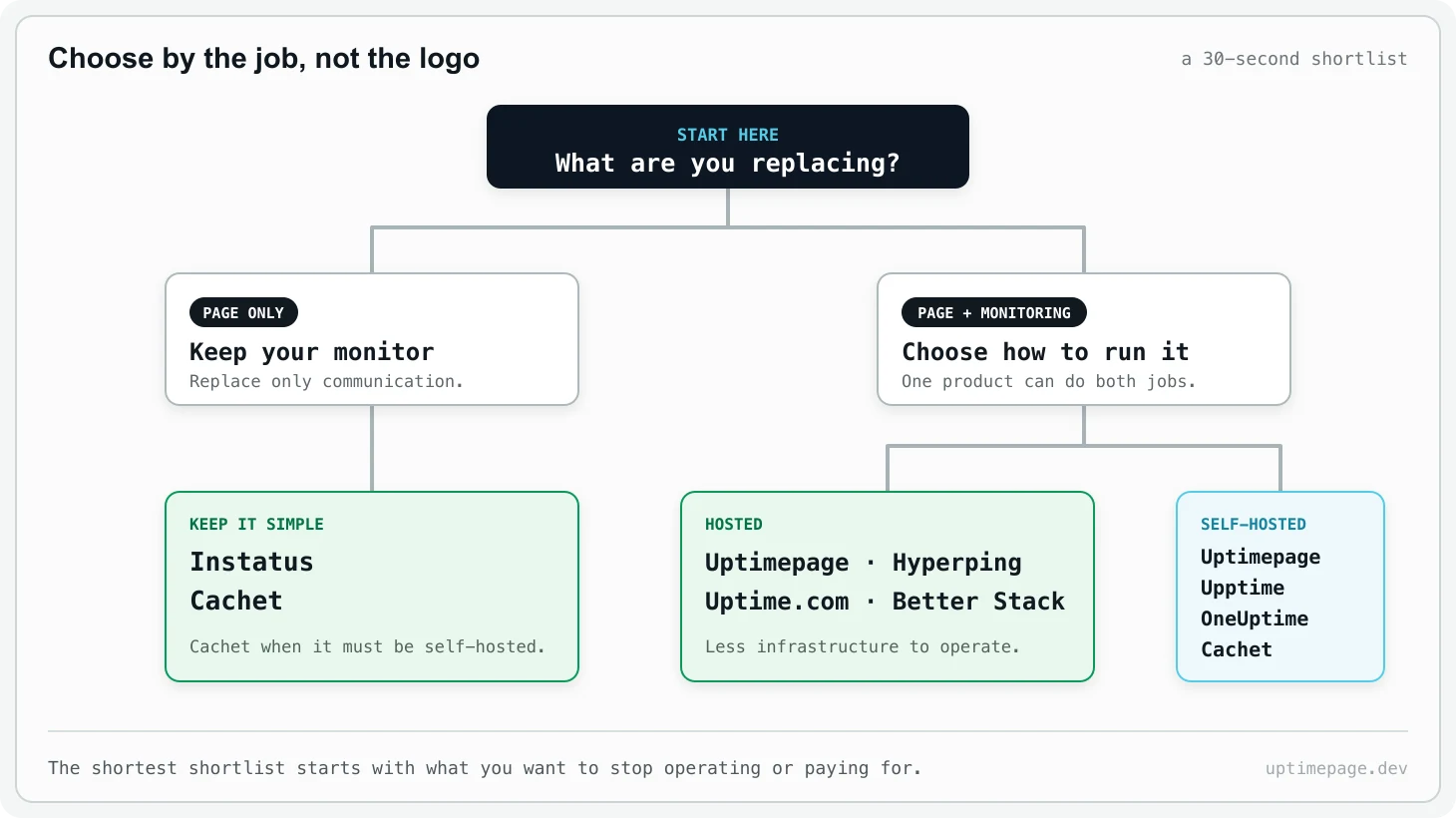
Start with what you are replacing. Keep your monitor and swap only the page, or consolidate both jobs in a hosted or self-hosted tool. Uptimepage supports either deployment model.
Answer one question first: are you replacing the page, or the page and the monitor?
If you want one product for monitoring and the public page, start with Uptimepage. Use the hosted service when you do not want infrastructure to operate, or self-host the same application when control and data ownership matter. There is no subscriber meter in either model.
The exceptions are about scope. If you like your existing monitoring and only the page annoys you, choose Instatus, or Cachet when that page must be self-hosted and its licence works for you. Choose Better Stack when logs and advanced on-call are part of the purchase, Hyperping when you want a hosted monitoring and incident-response suite, and Uptime.com when a broad probe network and procurement support matter. If you want a fully self-hosted operations platform and are prepared to run it, compare Uptimepage with OneUptime. Upptime remains the lightweight answer for GitHub-based projects that can accept five-minute checks.
Whatever you pick, decide what your uptime number means before you publish it, because your customers will treat that percentage as a promise. If you are also putting the number in a contract, what an uptime SLA actually promises is worth ten minutes of your time first.
Common questions
Does Atlassian Statuspage do its own uptime monitoring?
No, and this surprises people. Statuspage shows the status that you or an integration report to it. Something else has to notice the outage first, which is why a Statuspage bill is usually a second bill on top of a monitoring tool.
Is there a free Statuspage alternative?
Yes. Uptimepage has a free hosted tier with monitoring included and can also be self-hosted. Instatus, Hyperping and Better Stack have free hosted tiers too. Upptime and OneUptime are open source and free at any size if you host them, and Cachet is free to host, though its v3 licence is source-available rather than open source.
Why do teams leave Statuspage?
Usually the subscriber pricing. The price goes up with how many people can subscribe to updates, so the bill grows with the audience you most want to reach. Add the separate monitoring tool it needs, and the page costs more than the checks behind it.
What is the cheapest way to run a branded status page?
Use Uptimepage's free hosted tier if you want monitoring and a branded page without operating a server, or self-host it on infrastructure you already pay for. Upptime, OneUptime and Cachet can also be self-hosted for the cost of your time and a host, though only the first two are open source.